
The journal — Beef tips
The difference between Black Angus and Wagyu, cut by cut
Two names that thrill meat lovers, yet two very different worlds. Here, without jargon, is what truly separates Black Angus from Wagyu — from breed to plate.
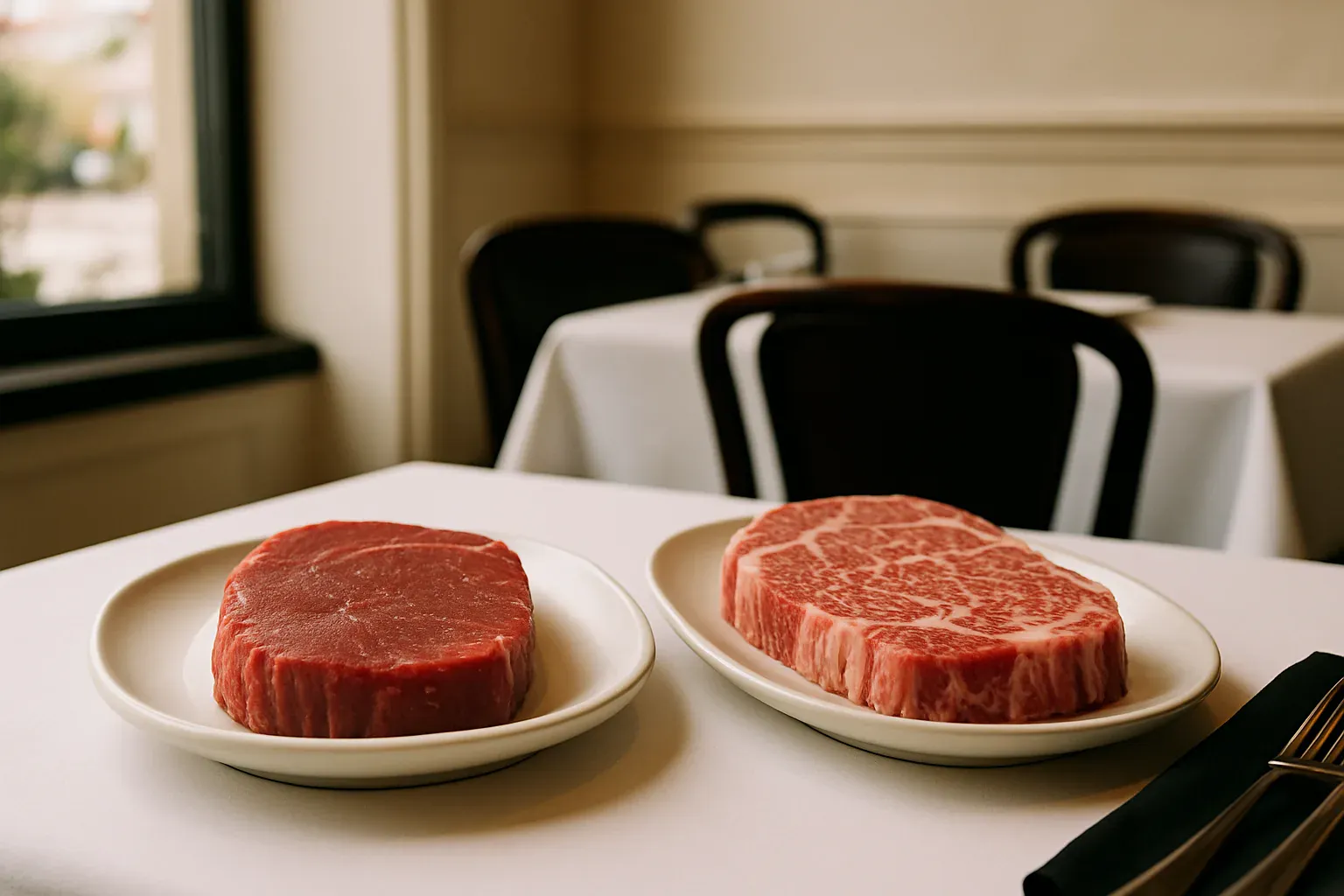
The essentials in thirty seconds
Black Angus is a Scottish breed with fine, even marbling: a straightforward, tender beef with a strong beef flavour, perfect for a generous rib-eye. Wagyu refers to Japanese breeds with extreme marbling whose fat melts at low temperature for a buttery, melting texture, served in small tasting portions. Neither is 'better' — it depends on the occasion.
Origins
Two breeds,
two worlds
Black Angus is a Scottish breed — black, hornless, hardy — now raised worldwide for its reliably tender, flavourful beef. It is one of the most widespread beef breeds and a steakhouse staple.
Wagyu is not one breed but a family of Japanese breeds — literally 'Japanese beef'. The most famous is the Japanese Black, source of the celebrated Kobe beef, a specific lineage raised under strict rules. Angus spread through reliability; Wagyu built a reputation for rarity.

The key
Marbling, the real tipping point
If one criterion sets them apart, it is marbling — the fine veins of fat that melt with heat and baste the meat from within, deciding juiciness and much of the flavour.
Black Angus has fine, even marbling: it still eats like real beef, with a satisfying chew. Wagyu pushes marbling to a spectacular level, a dense web of fat that melts at very low temperature — hence its unique melt-in-the-mouth sensation, graded on a dedicated marbling scale.

In the mouth
Taste and texture
Black Angus delivers a frank, assertive beef flavour and a satisfying chew — a generous meat made to be shared and paired.
Wagyu is buttery, almost silky, with rare umami power. It melts rather than chews, and a few bites often suffice. You taste it like a great wine, in small portions.
Upstream
Farming and feed
Flavour is decided far from the kitchen too. Three differences shape everything.
Duration
Wagyu is raised over a notably long, careful period, favouring the intramuscular fat that is its signature.
Feed
Black Angus often mixes grass and grain finishing; Wagyu follows a tightly controlled, grain-rich diet for abundant marbling.
Standards
Prestigious Japanese lines follow strict traceability and grading; Angus relies more on the consistency of the breed itself.

Ageing
Ageing and
maturing
Ageing concentrates aromas and tenderises the fibre. It especially suits Black Angus: a few weeks of dry-ageing deepen its beef flavour. Wagyu, already very tender, needs only a short ageing — its interest lies in the quality of its fat.
- 01Young, well-bred meat with a known origin.
- 02Controlled cold rest that concentrates aromas.
- 03Ageing matched to the cut: longer for Angus, shorter for Wagyu.
- 04Cutting at the last moment, at the point of balance.
In the pan
Two beefs, two cooks
Their fat reacts differently to heat, so they cook differently.
Black Angus
Handles large cuts and classic cooking: sear hard for a crust, cook to the wanted doneness, then rest. The ideal generous rib-eye.
Wagyu
Its melting fat demands restraint: small portions, short and fierce, barely seared. Overcooked, it loses its magic and turns greasy.
Resting
In both cases resting is sacred: it lets the juices settle back into the muscle. Patience is the best sauce.
In short
At a glance
Two profiles, two pleasures.
The right pick
Which to choose
There is no absolute winner, only cravings. For a real, convivial meat meal with character and chew to share, Black Angus is unbeatable — the very definition of a fine rib-eye.
For an exceptional moment, the most intense sensation in a few bites, Wagyu wins. Many end up loving both — not one against the other, but each for what the other cannot offer.
To correct
Myths to drop
- 'Wagyu means Kobe.' No: Kobe is a precise, rare appellation within the vast Wagyu world.
- 'Black Angus is always American.' False: the breed is Scottish and now raised worldwide.
- 'More fat means less healthy.' Wagyu fat is particular, richer in unsaturated fatty acids than assumed.
- 'Wagyu cooks like a big rare steak.' The classic mistake: it wants small, barely seared portions.
At our place
At our table
At L'Entrecôte de Dubaï, our choice is fine aged beef, with Black Angus in the lead role: a generous rib-eye seared to order, served with the respect it deserves.
And because a great cut calls for a great wine, our sommelier guides you through a cellar of over 200 references to find the pairing that reveals the meat.
Discover the wine cellardécouvrir notre Wagyu
Frequently asked
Black Angus and Wagyu, in practice
What is the main difference between Black Angus and Wagyu?
Marbling. Black Angus has fine, even marbling for a frank, tender beef; Wagyu has extreme marbling whose fat melts at low temperature, giving a buttery, melting texture.
Is Wagyu always Kobe beef?
No. Wagyu means all Japanese beef breeds. Kobe is a precise, rare appellation from Hyogo prefecture, raised under strict rules.
Does Black Angus only come from the US?
No. The Aberdeen Angus breed is Scottish and is now raised worldwide, notably in the US, Australia and Argentina.
Which one for a real meat meal?
For a generous rib-eye to share, with beef flavour and chew, Black Angus is ideal. Wagyu is better for an exceptional tasting in small portions.
Do you cook Wagyu like a classic steak?
No. Its melting fat needs short, fierce cooking in small, barely seared portions. Overcooked, it turns greasy.
Should both be aged?
Ageing mostly benefits Black Angus, whose flavour deepens over a few weeks. Wagyu, already very tender, needs only short ageing.
Read on
Find all our practical guides, pairings and steakhouse know-how in our conseils viande et vin.
Keep exploring
Fancy a fine aged steak?
Black Angus rib-eye seared to order, a cellar of over 200 references and service until 1 a.m., in Plan de Campagne.