
The journal — Beef tips
How to cook a rib-eye steak
A great rib-eye is a matter of minutes, but everything is decided before it hits the pan. Here is the method we follow in our kitchen every night, from choosing the cut to the final rest.
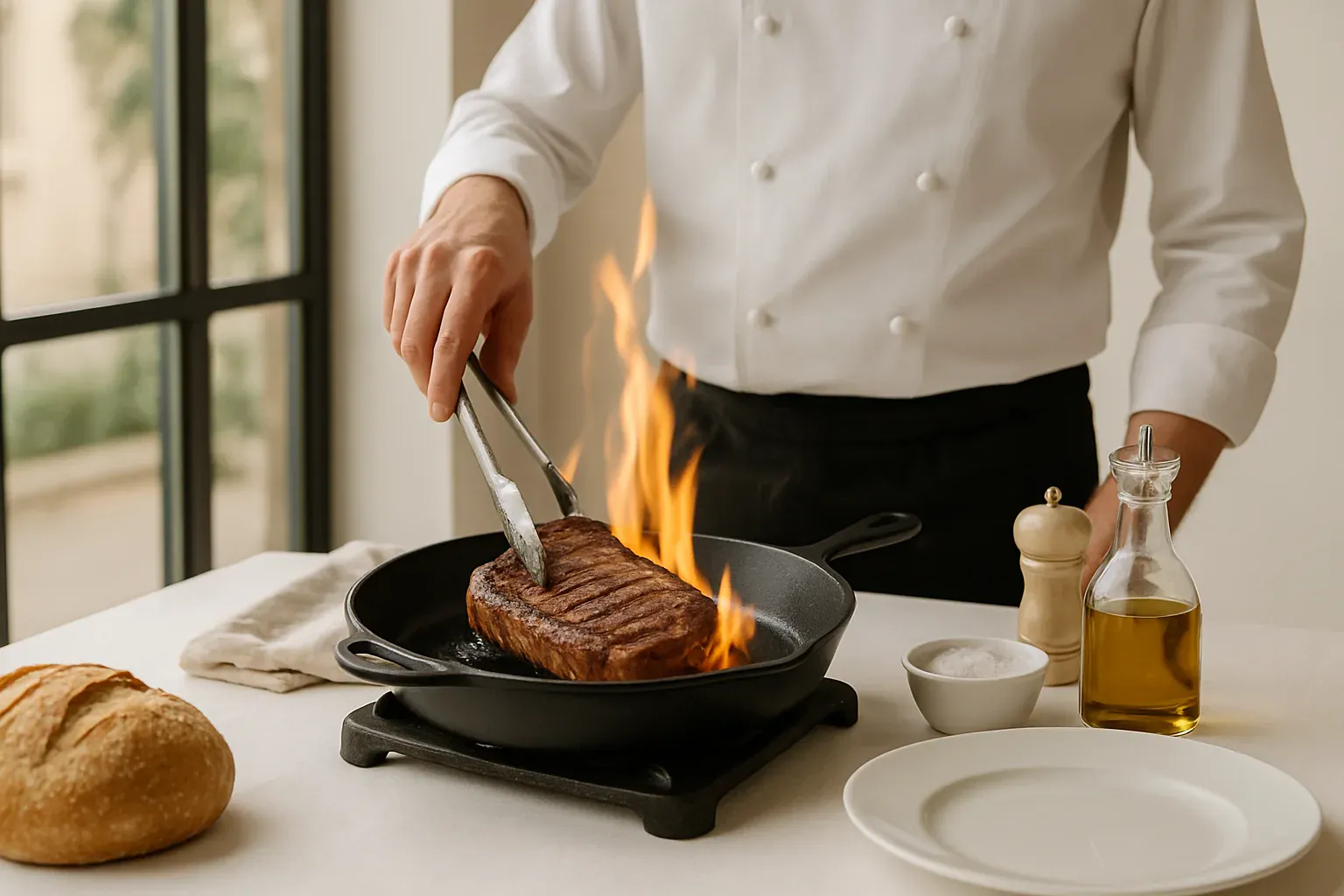
The essentials in thirty seconds
To succeed with a rib-eye: take it out of the fridge 30 to 45 minutes ahead, pat it dry, salt it just before searing. Heat a cast-iron pan very hot, sear 2 to 3 minutes per side for rare to medium, then rest the meat 5 minutes under foil before slicing. A core thermometer (55 °C rare, 60 °C medium) removes all guesswork.
The cut
Choosing the
right rib-eye
It all starts with the cut. The rib-eye is taken from the rib section, and its marbling — fine veins of fat that melt with heat — is the first sign of a steak that stays tender and full of flavour.
Aim for at least three centimetres thick and 250 to 300 grams per person. Aged beef, such as Black Angus, develops deeper aromas and a softer texture — exactly what we serve in the dining room.
Vous souhaitez goûter l'entrecôte de la maison ? Notre entrecôte Black Angus maturée vous attend à Plan de Campagne.
The prep
Out of the fridge
The most common mistake: throwing an ice-cold steak into the pan. Straight from the fridge, it burns outside while the core stays cold.
Take the meat out 30 to 45 minutes before cooking, then pat it thoroughly dry. A dry, room-temperature steak is what lets a proper crust form.
The gear
The right gear
No professional kit needed — three things are enough, as long as they can take fierce heat.
The pan
Cast iron or heavy steel that holds heat. Avoid non-stick, which never gets hot enough to sear.
The fat
A high-heat oil to sear, then a knob of butter with garlic and thyme to baste at the end.
The thermometer
A core probe removes all guesswork and gives the exact doneness every time.
Seasoning
Salt and pepper
at the right time
Salt both sides generously just before searing, on a dry steak. Applied at the last moment, it seasons deeply without harming the crust.
Add pepper at the end: on high heat it burns and turns bitter. A few warm oriental spices lift the fat without masking the beef — the seasoning should serve the meat, never cover it.
The cook
Searing,
step by step
- 01Heat the empty pan very hot, until it smokes. Fierce heat is the condition for a crust.
- 02Add oil, lay down the steak. It should sizzle at once. Don't move it — let it catch.
- 032 to 3 minutes untouched, until a brown crust forms. Turn once, then 2 to 3 minutes on the other side.
- 04Lower the heat, add butter, garlic and thyme, and baste for a minute for shine and aroma.
- 05Check the core, then move it straight to a warm plate to rest.
Doneness
Doneness levels
Core temperature is the only reliable guide. Times below are for a three-centimetre steak seared on high heat.
Blue
Sharp crust, barely warm red core. 1 to 2 minutes per side.
Rare
Warm red core, very juicy. 2 minutes per side.
Medium
Pink core, still juicy. 3 minutes per side. The safest choice.
Well done
No red left. Best kept for thin slices to avoid drying out.
The forgotten step
Resting
the meat
The step almost everyone skips, yet it separates a good rib-eye from a perfect one. Heat pushes the juices to the centre; slicing at once empties the meat onto the plate.
Rest the steak 5 to 8 minutes, loosely covered with foil. The fibres relax and the juices spread back through the muscle. Then slice against the grain for the most tender bite.
Around the steak
Sauces & sides
A great rib-eye stands alone, but a well-chosen side sets it off: home fries, creamy aligot, spinach or roast potatoes soak up the juices without stealing the show.
Keep the sauce simple — a pan reduction, a herb butter, a last-minute pepper sauce. At L'Entrecôte de Dubaï we like a subtle oriental note that extends the beef without dominating it.
To avoid
The mistakes that ruin a rib-eye
- Cooking meat straight from the fridge, still frozen at the core.
- Using a pan that isn't hot enough: the steak boils instead of searing.
- Turning it constantly, so the crust never forms.
- Piercing the meat with a fork: every hole lets the juice out.
- Salting far too early or peppering before high-heat cooking.
- Slicing straight off the heat, with no resting time.
The pairing
Which wine
with rib-eye
A great steak deserves a great wine. On a seared rib-eye, a full-bodied red stands up to the fat and the ageing, its structured tannins cleansing the palate between bites.
That is exactly what our cellar of over 200 references and our sommelier are for: finding the bottle that reveals your rib-eye rather than covering it.
La cuisson maîtrisée mérite un accord à la hauteur — et côté vin, notre guide dédié vous accompagne pour choisir la bouteille idéale.
Discover the wine cellar
Frequently asked
Cooking a rib-eye, in practice
How long does it take to pan-cook a rib-eye?
For a three-centimetre steak on high heat, about 2 minutes per side for rare, 3 minutes per side for medium. Always add 5 minutes of resting before slicing.
Should I salt the rib-eye before or after cooking?
Salt both sides generously just before searing, on a dry steak. Pepper goes on after cooking: on high heat it burns and turns bitter.
How do I check doneness without cutting the steak?
A core thermometer is safest: 50 °C blue, 55 °C rare, 60 °C medium, 68 °C well done. Otherwise, the firmer the meat feels, the more it is cooked.
Why rest the meat after cooking?
Resting lets the juices, driven to the centre by heat, spread back through the muscle. A rib-eye sliced with no rest loses its juice and dries out.
Pan or barbecue for a rib-eye?
Both work if the heat is intense. Cast iron gives perfect control and lets you baste with butter; the barbecue adds smoke. What matters is a fierce heat and a proper crust.
How thick should a good rib-eye be?
At least three centimetres. A thinner slice cooks through before a crust forms, losing the contrast between grilled outside and pink inside.
Read on
Find all our practical guides, pairings and steakhouse know-how in our conseils viande et vin.
Keep exploring
Rather not cook tonight?
Leave it to the kitchen: aged rib-eye seared to order, a cellar of over 200 references and service until 1 a.m., in Plan de Campagne.